
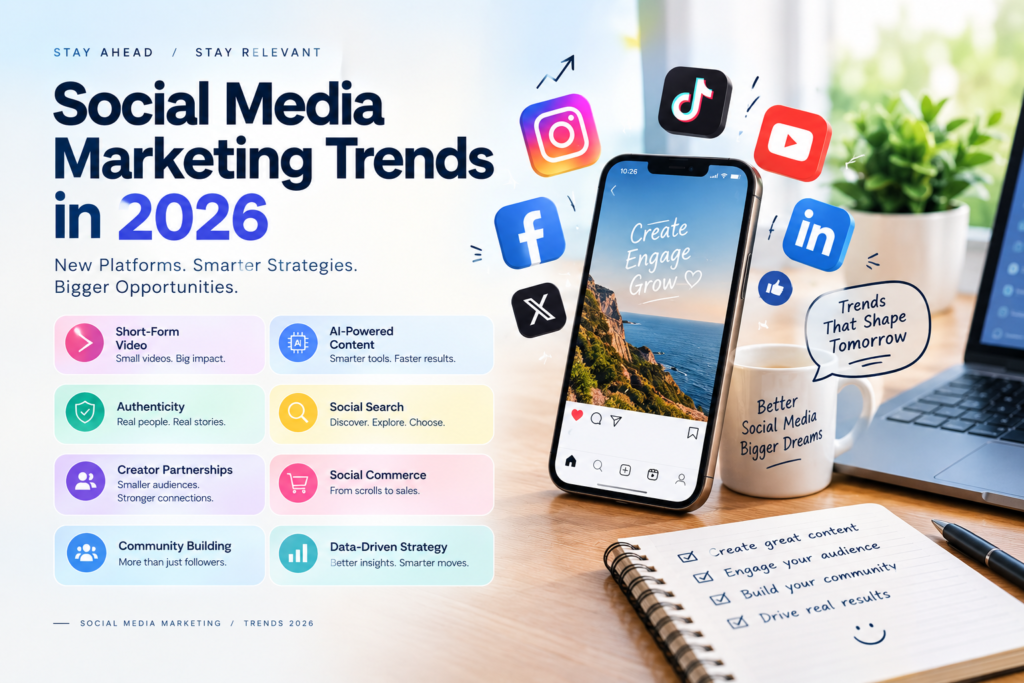
Social media marketing continues to evolve rapidly in 2026. Platforms are no longer used only for sharing photos, videos, and updates. They have become important channels for discovery, customer service, brand building, community engagement, and online shopping.
For businesses, this means that simply posting regularly is no longer enough. Brands need to understand how people discover content, what formats attract attention, and how artificial intelligence is changing the way social media content is created.
Recent research from HubSpot shows that 94% of social media marketers use AI in their workflows, while 77% say authenticity is more important than production value.
So, what are the biggest social media marketing trends in 2026? Let’s explore them.
1. Short-Form Video Continues to Dominate
Short-form video remains one of the most important social media marketing trends in 2026. Instagram Reels, TikTok videos, YouTube Shorts, and Facebook videos provide businesses with opportunities to reach audiences quickly.
HubSpot’s 2026 research identifies short-form video as the most-used content format and the format receiving the highest planned investment.
Businesses can use short-form videos to:
- Introduce products and services
- Share educational tips
- Show behind-the-scenes content
- Answer customer questions
- Share testimonials
- Demonstrate products
- Tell short brand stories
The key is to capture attention quickly and provide value instead of creating videos simply for the sake of posting.
2. AI Becomes Part of Everyday Social Media Marketing
Artificial intelligence is becoming an important part of social media workflows. Marketers are using AI for brainstorming, captions, images, videos, content planning, and editing.
HubSpot reports that 94% of social media marketers use AI in some capacity, with common applications including ideation, captions, image generation, and image editing.
AI can help businesses save time and produce content more efficiently. However, businesses should avoid publishing generic AI-generated content without human editing.
The strongest approach is to use AI as a productivity tool while keeping human creativity, brand personality, and authenticity at the center of the content strategy.
3. Authentic Content Matters More Than Perfect Production
Highly polished advertisements are no longer the only way to attract attention. Audiences increasingly respond to content that feels natural, relatable, and genuine.
According to HubSpot’s 2026 research, 77% of social media marketers say authenticity is more important than production value.
This creates opportunities for small businesses that may not have large marketing budgets.
A simple video recorded in a real workplace can sometimes communicate more effectively than an expensive advertisement. Businesses can show employees, customer experiences, product demonstrations, daily operations, and behind-the-scenes moments to make their brands feel more human.
4. Social Media Is Becoming a Search Engine
People increasingly use social platforms to discover businesses, products, services, reviews, tutorials, and recommendations.
HubSpot’s 2026 research indicates that social search is becoming an important part of the discovery journey, particularly among younger consumers.
This means businesses should think about social media SEO.
Use relevant keywords in:
- Captions
- Video titles
- On-screen text
- Profile descriptions
- Hashtags
- Image descriptions
For example, a digital marketing agency in Kerala could naturally use phrases such as “digital marketing services in Kerala” or “social media marketing for small businesses” in relevant posts.
5. Micro and Mid-Tier Creators Are Gaining Importance
Influencer marketing is becoming more focused on relevance, engagement, and audience connection rather than follower count alone.
HubSpot’s 2026 research shows that marketers are continuing to increase influencer investment, while mid-tier creators delivered strong results in its survey.
Smaller creators can be valuable because they often have focused communities around specific interests.
For example, a local restaurant could collaborate with food creators who have a strong regional audience rather than choosing a creator solely because they have millions of followers.
The right creator should match the brand, target audience, content style, and campaign objective.
6. Community Building Becomes a Major Strategy
Social media is moving beyond simply collecting followers. Building an active community is becoming increasingly important.
Businesses can create stronger communities by:
- Responding to comments
- Asking questions
- Starting discussions
- Sharing user-generated content
- Creating exclusive groups
- Hosting live sessions
- Listening to customer feedback
A strong community can help businesses develop long-term relationships instead of relying only on individual viral posts.
7. Social Commerce Continues to Grow
Social media and online shopping are becoming increasingly connected. Customers can discover products through social content and move closer to purchasing without leaving the platform.
HubSpot identifies social commerce as one of the major shifts shaping social media in 2026, with marketers expecting more shopping activity to happen through social platforms.
Businesses can use product videos, demonstrations, reviews, creator partnerships, live shopping, and social advertisements to support the customer journey.
For e-commerce businesses, social media should therefore be considered both a branding channel and a potential sales channel.
8. Platform-Specific Content Is More Important
One piece of content should not necessarily be copied exactly across every platform.
Different platforms have different audiences, content formats, algorithms, and user expectations. HubSpot’s 2026 research highlights the importance of going deeper on fewer platforms rather than trying to maintain a weak presence everywhere.
For example:
Instagram: Reels, Stories, carousels, and visual storytelling
TikTok: Short videos, entertainment, trends, and creator content
LinkedIn: Professional insights, industry knowledge, and thought leadership
YouTube: Short-form and long-form educational videos
Creating platform-specific content can make social media marketing more relevant and effective.
9. Data and Analytics Drive Better Decisions
Social media marketing is becoming increasingly data-driven. Businesses need to understand what content is generating meaningful results rather than focusing only on follower numbers.
Important metrics include:
- Reach
- Engagement rate
- Watch time
- Click-through rate
- Leads
- Conversions
- Website traffic
- Sales
- Customer interactions
Regularly reviewing these metrics can help marketers understand which topics, formats, and platforms are performing well.
10. Human Creativity Still Matters
Although AI is transforming social media marketing, human creativity remains essential.
AI can help generate ideas and accelerate production, but people provide brand personality, emotional understanding, original experiences, and strategic judgment.
The combination of AI efficiency and human creativity is likely to become an important part of social media marketing in 2026.
How Businesses Can Prepare for Social Media Marketing in 2026
Businesses do not need to follow every trend at once. Instead, they should choose trends that match their audience and business objectives.
A practical strategy is to:
- Identify your target audience.
- Choose the platforms where they are active.
- Create more short-form video content.
- Optimize posts for social search.
- Experiment with AI-assisted content creation.
- Focus on authentic and useful content.
- Work with relevant creators when appropriate.
- Build an engaged community.
- Track meaningful performance metrics.
- Adjust the strategy based on results.
Conclusion
The social media marketing trends in 2026 show that social media is becoming more than a place to publish content. It is becoming a complete environment for discovery, communication, community building, shopping, and brand growth.
Short-form video, AI-assisted content creation, social search, creator marketing, authenticity, community building, and social commerce are all shaping the current social media landscape.
However, trends alone do not guarantee success. Businesses need to understand their audience, create valuable content, maintain an authentic brand voice, and continuously measure their results.
In 2026, successful social media marketing is not simply about posting more. It is about creating better, more relevant, authentic, and audience-focused experiences.